Before anyone visits your page, they see it in one of two places: a Google result or a link shared on WhatsApp, Facebook or LinkedIn. Both are built from a few lines in your page's code: the title tag, the meta description and the Open Graph tags.
These lines don't take long to write, and they decide whether people click. Rewriting a weak title is often the single change that makes the biggest difference to traffic from a page that already ranks.
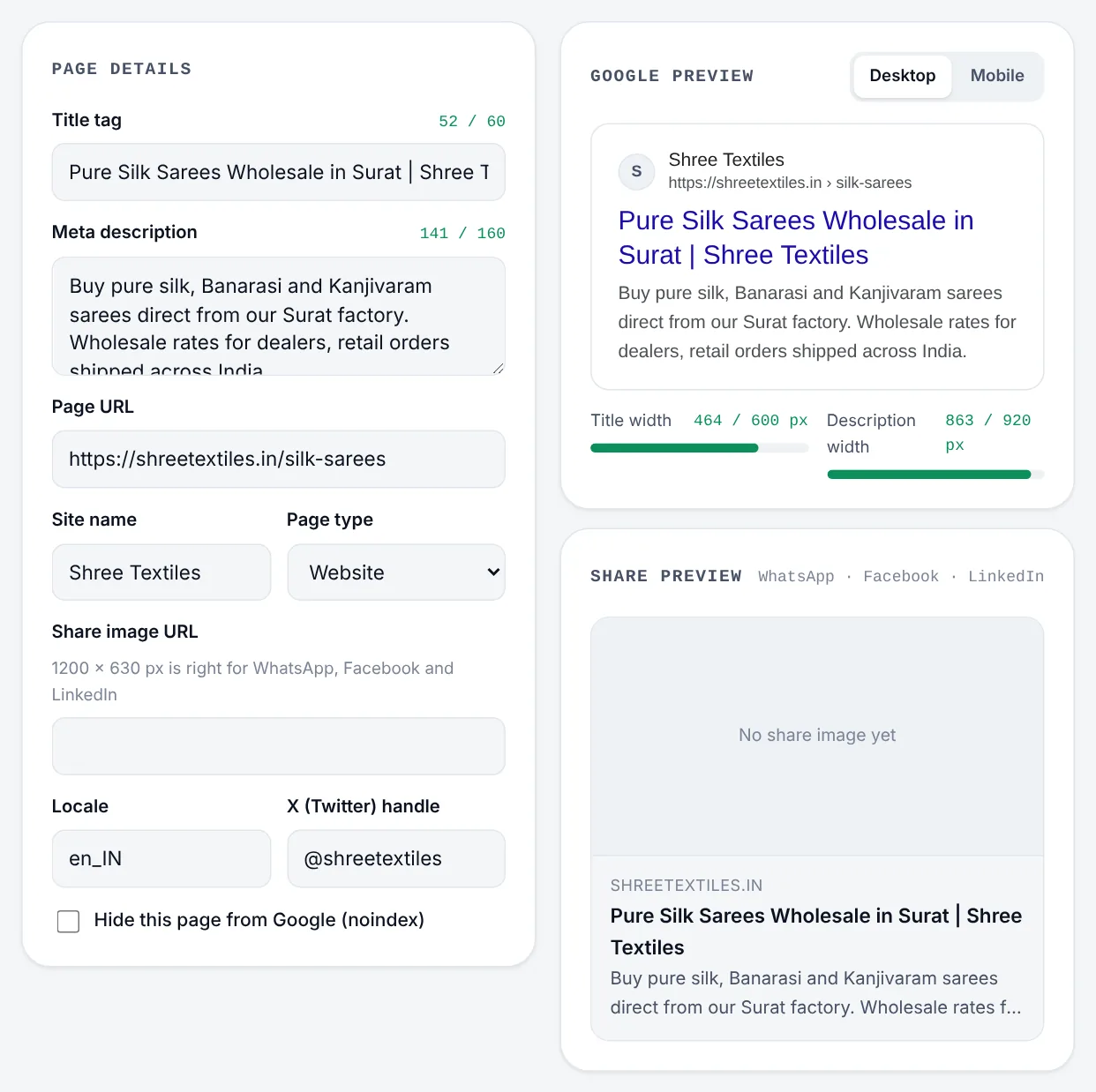
The title tag
The title tag is the clickable blue headline in Google results. It's also the text in the browser tab and the default headline when someone shares your page.
<title>Pure Silk Sarees from Surat | Shree Textiles</title>
In WordPress, Shopify, Wix and most builders you don't touch the code. You fill an "SEO title" field in the page settings or in a plugin such as Yoast or Rank Math.
How long?
Google cuts titles wider than about 600 pixels on desktop, which is roughly 50 to 60 characters. Pixels matter more than characters, because wide letters like W and M take more room than i and l. Put the important words first so a cut never removes them.
Google also rewrites titles that are too long, stuffed with keywords or don't match the page. A clear, accurate title is far more likely to be shown as you wrote it.
A formula that works
Main search phrase + what makes you different + brand
Pure Silk Sarees from Surat | Shree TextilesBathroom Waterproofing in Ahmedabad, 5-Year Warranty | Bhanderi BuildconFree IP Address Lookup with City and ISP | IPLocator Tools
The search phrase goes first because people scan the start of each result for the words they typed. The brand goes last because it matters most to people who already know you.
Before and after
| Before | After |
|---|---|
| Home | Wedding Photographer in Rajkot, Candid and Traditional |
| Products | Stainless Steel Kitchen Sinks, Factory Prices |
| Blog Post 14 | How to Choose a Water Purifier for Hard Water |
| Welcome to ABC Clinic | Dental Clinic in Vadodara Open Sunday, ABC Dental |
Every "after" tells the searcher what they'll get before they click.
Titles for each type of page
- Home page: what you do and where, then the brand.
Interior Designers in Surat for Homes and Offices | Studio Nine - Product page: the product name as people search for it, a key detail, then the brand.
- Service page: the service, the city and something that sets you apart.
- Blog post: the question or the promise.
How to Remove Hard Water Stains from Tiles - Category page: the category in plural with a qualifier.
Cotton Kurtis for Women, Under ₹999
When the headline is too long
Guide headlines are often longer than 60 characters. The fix is to keep two versions: a full headline for the page and a shorter title tag for Google. Rankdesk's guides do exactly that. This guide's headline is 65 characters, so its title tag is a shorter "Title Tags, Meta Descriptions and Share Previews". The site only adds "| Rankdesk" to the end of a title tag when it still fits within 60 characters, so the brand never pushes the topic out of view.
Title tag rules
- Make every title unique. If ten pages share one title, Google can't tell which to show.
- Match the page. If the title promises prices, show prices. A mismatch sends people straight back to the results.
- Write for people. "Saree, sarees, buy saree, saree online" reads as spam. One natural phrase is enough.
- Use true specifics: "5-year warranty", "open Sunday", "12 examples".
- Separate parts with
|or a dash, and use the same one across the site.
The title and the H1
The H1 is the main heading on the page itself. It can match the title tag or be a slightly longer, friendlier version, as long as both describe the same topic. The on-page SEO guide covers headings in detail.
The meta description
The meta description is the grey text under the title in Google results. It doesn't change where you rank, but it strongly affects whether people click. Think of it as a two-line advert for the page.
<meta name="description" content="Pure Banarasi and Kanjivaram silk sarees direct from our Surat looms. Wholesale rates for dealers and delivery across India.">
Length, and whether Google uses it
Google trims descriptions at roughly 150 to 160 characters on desktop, and less on mobile. Put the most important information in the first 120 characters so it survives either way.
Google often shows a different sentence from the page when it thinks that sentence matches the search better. You can't force your description, but a clear one that matches the page's main topic is used far more often.
A simple formula
What the page offers + a detail that matters to the searcher + a reason to act
The detail that matters is usually price, location, speed, proof or something free.
12 examples
Shops and products
- Silk sarees: "Pure Banarasi and Kanjivaram silk sarees direct from our Surat looms. Wholesale rates for dealers and delivery across India."
- Kitchen sinks: "Stainless steel kitchen sinks in 30+ sizes, with a 10-year rust warranty. Factory prices, free delivery in Gujarat."
- Home bakery: "Eggless custom cakes in Ahmedabad, baked to order. Order on WhatsApp by 2 pm for same-day delivery."
Services
- Waterproofing: "Terrace and bathroom waterproofing in Ahmedabad with a 5-year written warranty. Free site inspection within 48 hours."
- Dentist: "Painless root canals, braces and implants in Vadodara. Open Sundays. Book online or call for an appointment today."
- CA firm: "GST registration, returns and income tax filing for small businesses in Rajkot. Fixed monthly fees, no surprises."
Tools and software
- IP lookup: "Find the city, country and internet provider of any IP address. Free, instant and no signup needed."
- Invoice app: "Create GST invoices on your phone in under a minute. Free for up to 50 invoices a month."
- SEO audit: "Check any page for title, meta tags, schema, speed and crawl problems. Free SEO audit with a fix list in 20 seconds."
Guides
- How-to: "Learn the burn test, the ring test and four other ways to check whether a saree is pure silk before you buy."
- Comparison: "Waterproofing coating or tiling: we compare cost, lifespan and leak risk for Indian terraces, with real prices."
- Checklist: "A 20-point local SEO checklist for shops and service businesses, from Google Business Profile to reviews."
None of them repeat a keyword awkwardly, and every one gives the reader something specific.
Meta description mistakes
- Leaving it empty. Google then picks any text from the page, often your menu or cookie notice.
- One description copied across many pages. Every page needs its own.
- Keyword lists. "Sarees, silk sarees, buy sarees, sarees Surat" looks like spam and gets ignored.
- Promising what the page doesn't deliver. People go straight back to the results.
- A double quote inside the text. In the code,
"ends the attribute early and cuts the description off.
Share previews: Open Graph tags
When you share a link on WhatsApp, Facebook, LinkedIn or X, the app shows a card with a title, a short description and an image. That card comes from Open Graph tags. Without them, apps guess, and you get a cropped logo, the wrong text or no image at all. For many Indian businesses WhatsApp is where links get shared most, so this card is often seen more than the Google result.
<meta property="og:title" content="Pure Silk Sarees from Surat">
<meta property="og:description" content="Banarasi and Kanjivaram sarees direct from our looms. Delivery across India.">
<meta property="og:image" content="https://shreetextiles.in/og/silk-sarees.jpg">
<meta property="og:url" content="https://shreetextiles.in/silk-sarees">
<meta property="og:type" content="website">
<meta property="og:site_name" content="Shree Textiles">
<meta name="twitter:card" content="summary_large_image">
- og:title is the card headline. It can be your full headline, because share cards allow more room than Google. Rankdesk uses each guide's full headline here and the shorter version in the title tag.
- og:description: one or two sentences, most important part first.
- og:image: the full
https://address. Relative paths like/og.jpgoften fail. - og:url: the page's preferred address, the same as its canonical tag.
- og:type:
websitefor most pages,articlefor blog posts,productfor products. - twitter:card with
summary_large_imagegives a large image on X, which otherwise reads the Open Graph tags.
The share image
- 1200 × 630 pixels works on WhatsApp, Facebook, LinkedIn and X.
- JPG or PNG, well under 1 MB. Very large images may not show on WhatsApp.
- Keep text and logos away from the edges. Some apps crop to a square.
- A real photo or a simple graphic with the page title. Small text is unreadable on a phone.
- A different image for each product or article looks far better than one logo everywhere.
When the preview won't update
Apps save previews, so changing your tags doesn't change links already shared. On Facebook and Instagram, paste the address into the Sharing Debugger and click "Scrape again". On LinkedIn, use the Post Inspector. WhatsApp caches too: sharing the address with a small change, such as ?v=2, usually forces a fresh preview.
Share preview mistakes
- No og:image, so the app picks a random image or none.
- A logo as the image, cropped badly in square previews.
- The same title and image on every page.
- The image blocked by robots.txt or a login, so apps can't fetch it.
- Tags added by JavaScript after the page loads. Most apps read the raw HTML and don't run scripts.
Write all three together
People read the title and description as one unit, and the share card is the same message in another place. Write them in one sitting:
- Decide the main search phrase for the page.
- Write the title: phrase first, the detail that sets you apart, then the brand.
- Write the description: what the page offers, one specific detail, a reason to act.
- Choose a 1200 × 630 image that shows what the page is about.
- Preview all three before you publish.
The Rankdesk meta tag generator does step 5 live. It measures the title and description in pixels, shows the desktop and mobile Google result and the share card, and gives you every tag to paste into your page's head, including the canonical. The SEO audit checks existing pages for missing or too-long titles, descriptions and Open Graph tags.